
Wounded Titans Meet Sooryavanshi’s Flying Royals for a Place in the Final
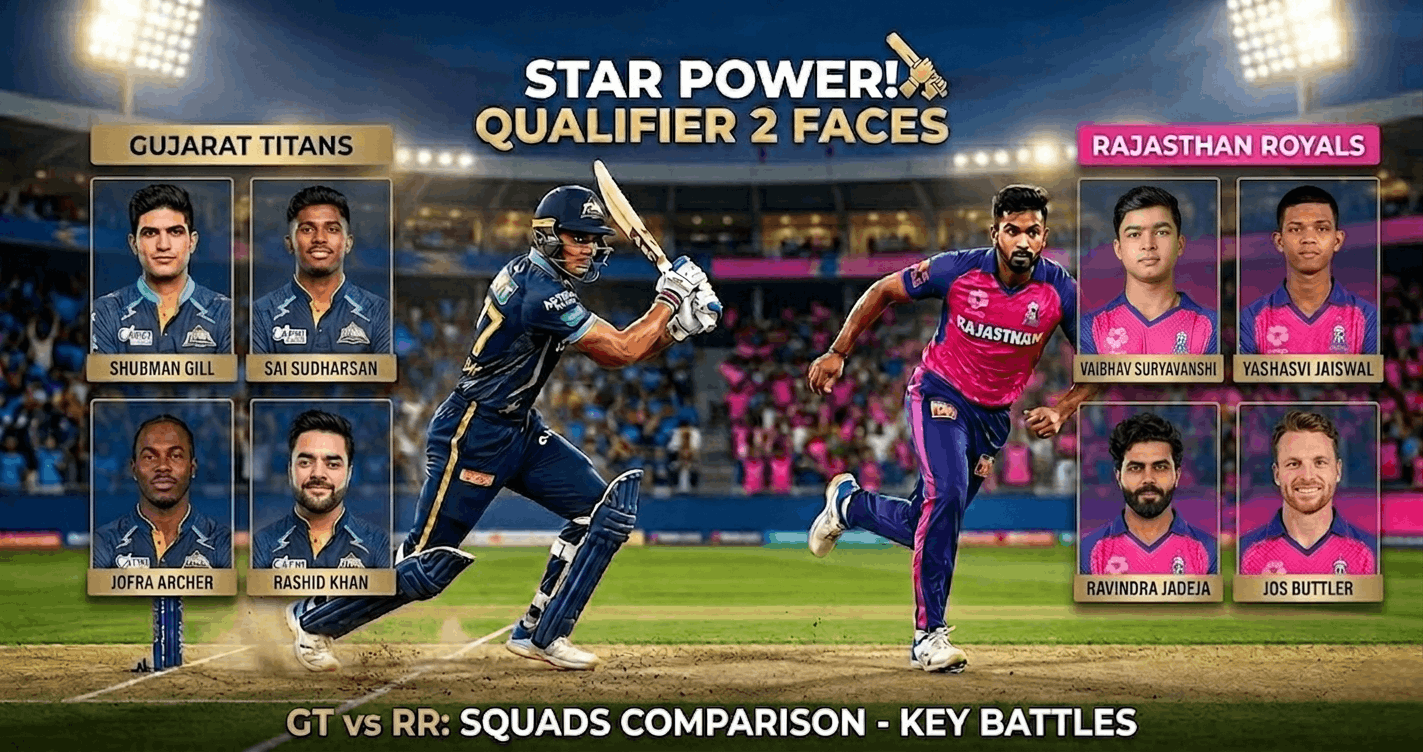
A deeply analytical preview of Gujarat Titans vs Rajasthan Royals at the Maharaja Yadavindra Singh International Cricket Stadium.
The road to the grand finale of the 2026 Indian Premier League has converged on the picturesque enclave of New Chandigarh. Here, at the Maharaja Yadavindra Singh PCA Stadium in Mullanpur, two modern heavyweights will engage in a high-stakes tactical chess match. On Friday, May 29, 2026, the Gujarat Titans (GT) and the Rajasthan Royals (RR) cross swords in Qualifier 2. The objective is singular and uncompromising: to claim the remaining ticket to Ahmedabad for a date with a waiting Royal Challengers Bengaluru on May 31. For the winner, cricketing immortality remains within arm's reach; for the loser, an arduous two-month campaign ends in sudden, agonizing elimination.
The narrative background of these two units could not be more distinct. Gujarat Titans, under the shrewd custodianship of Shubman Gill, are actively seeking psychological rehabilitation. Having finished comfortably near the top of the league phase, they were handed a severe 92-run thrashing by RCB in Qualifier 1 at Dharamshala—a defeat that fractured their aura of clinical consistency. Conversely, the Rajasthan Royals enter the fray riding a wave of sheer, unchecked momentum. Their Eliminator performance against Sunrisers Hyderabad was nothing short of a demolition derby, catalyzed by an innings that redefined the boundaries of modern T20 power-hitting.

"Knockout cricket strips away regular-season achievements. It doesn't matter if you won by 80 runs last week or lost by 90 runs yesterday. Tomorrow, the team that manages the first six overs of both innings with technical clarity will walk onto the flight to Ahmedabad." — Cricketing Wisdom
Gujarat Titans: Seeking Structural Redemption
The Core Philosophy
Throughout the IPL 2026 campaign, Gujarat's blueprint has mirrored a well-oiled corporate machine. They prioritize defensive control through defensive bowling squeeze, high-percentage anchor batting at the top, and late-order calculated explosions. However, their 92-run capitulation against RCB exposed a fragile soft underbelly: if their top three fail to set a foundational platform, the middle order lacks the natural recovery gear to combat aggressive, high-pace bowling lines.
Batting Dynamics & Tactical Roles
The batting strategy revolves entirely around the axis of Shubman Gill and Sai Sudharsan. When this duo functions effectively, they neutralize the opposition's primary swing weapons by utilizing crisp, technical footwork and flawless gap manipulation. Sudharsan has been a model of consistency this year, compiling runs at an average north of 45, while Gill possesses the inherent pedigree to control the tempo of an entire 20-over block.
The inclusion of veteran overseas asset Jos Buttler has added an explosive element of dynamism to their ranks. However, batting away from his traditional opening spot has occasionally disrupted his natural rhythm. In the middle overs, the Titans rely heavily on Washington Sundar and the mercurial Rahul Tewatia to provide finishing impetus. The tactical problem for GT lies in their transitional phases. If an early wicket falls, their subsequent batters have frequently shown a tendency to retreat into a defensive shell, allowing opposition spinners to dictate terms during the critical 7-to-15 over window.
Bowling Architecture
On paper, Gujarat boasts perhaps the most balanced and tactically versatile bowling arsenal in the tournament. Led by the South African speed merchant Kagiso Rabada and the relentless Mohammed Siraj, their new-ball capabilities are formidable. Siraj provides the late tail-arm swing that troubles elite openers, while Rabada operates as the enforcer, extracting steep bounce from good lengths.
The middle-overs choke is masterfully engineered by the premier T20 spinner in world cricket, Rashid Khan. Supported by the seasoned tactical acumen of Jason Holder, Rashid acts as both a primary wicket-taking weapon and an economic dam. Holder’s ability to execute heavy-ball variations and cutters makes him an ideal defensive asset on drop-in surfaces. Yet, as RCB demonstrated, if an opposition line-up shows complete disregard for historical reputations and attacks their hard lengths early, this bowling unit can occasionally lose its structural discipline.
Rajasthan Royals: riding the Extravagant Wave of Youth
The Core Philosophy
The Rajasthan Royals are the antithesis of conservative cricket. Their operational mantra in 2026 has been defined by high-risk, high-reward tactical expressions. They look to maximize the powerplay to such an extreme degree that even when they suffer mid-innings collapses, the sheer velocity of their early run-accumulation keeps them ahead of par scores.
The Phenomenon of Vaibhav Sooryavanshi
No discussion on Rajasthan can commence without dedicating extensive analytical real estate to their teenage prodigy, Vaibhav Sooryavanshi. His stunning, record-obliterating 97 off just 29 deliveries against Sunrisers Hyderabad in the Eliminator was not merely an innings; it was a structural shift in T20 batting philosophy. Blasting 12 towering sixes, he single-handedly dismantled an international-grade bowling attack before they could even finalize their fields.
Sooryavanshi has surpassed legendary benchmarks for the most sixes hit within an IPL season, exhibiting a rare combination of hand-eye coordination and a low center of gravity that allows him to pull good-length deliveries over dead-cow corner with minimal fuss. Alongside the equally dangerous Yashasvi Jaiswal, Rajasthan possesses a left-handed opening pair capable of rendering any pre-match bowling plan entirely obsolete within the first 24 balls of the match.
Middle-Order Cushion & Strategic Bowling
Should the top-order fireworks experience an early extinguishment, the Royals are insulated by the tactical stability of Dhruv Jurel and the captaincy composure of Riyan Parag. Overseas assets like Donovan Ferreira and the experienced Shimron Hetmyer supply the lower-order muscle, ensuring that the team’s collective foot never leaves the accelerator.
With the ball, Rajasthan leans into the express pace of Jofra Archer and the left-arm angle of Nandre Burger. Archer’s early spell in the Eliminator was a masterclass in hostile, high-velocity target hitting, effectively breaking the spirit of the SRH top-order. When the field spreads, the enigmatic leg-spinner Ravi Bishnoi handles defensive duties. Bishnoi's quicker, skidding sliders offer a stark tactical contrast to Rashid Khan’s traditional drift and turn, making him exceptionally dangerous against middle-order batters trying to force the pace.
Recent Performances & Form Guide
The trajectory of both teams over the concluding weeks of the tournament indicates a significant divergence in psychological momentum. Let us examine their recent fixtures leading into this crucial Qualifier 2:
| Team | Match Type | Opponent | Outcome / Brief Score | Key Performer |
|---|---|---|---|---|
| Gujarat Titans | Qualifier 1 | RCB | Lost by 92 runs (GT 162 All Out) | Rajat Patidar (Opponent) |
| Gujarat Titans | League Match | CSK | Won by 89 runs (GT 229/4) | Mohammed Siraj (4 Wickets) |
| Gujarat Titans | League Match | KKR | Lost by 29 runs (GT 218/4) | Shubman Gill (84 Runs) |
| Rajasthan Royals | Eliminator | SRH | Won by 47 runs (RR 243/8) | Vaibhav Sooryavanshi (97 off 29) |
| Rajasthan Royals | League Match | MI | Won by 30 runs (RR 205/8) | Jofra Archer (3 Wickets) |
| Rajasthan Royals | League Match | LSG | Won by 7 wickets (RR 225/3) | Vaibhav Sooryavanshi (Half-Century) |
The contrast is stark. Rajasthan Royals are currently executing a flawless crescendo, stringing together high-velocity victories with their young talent performing at international elite standards. Gujarat Titans, conversely, present an irregular ledger—capable of putting up massive 220+ totals against Chennai, yet completely losing their systemic structure when confronted with aggressive, high-pressure situations like the one orchestrated by Bengaluru.
Historical Head-to-Head Dynamics
While current momentum favors the Pink Jersey, historical data offers a completely different narrative. Historically, the Gujarat Titans have held a distinct tactical hex over the Rajasthan Royals since entering the league.
- Total Confrontations: 10 Matches
- Gujarat Titans Victories: 7
- Rajasthan Royals Victories: 3
Even within the current 2026 season, the honors are evenly split, with each team registering a victory on enemy territory. In their first meeting at Guwahati, Rajasthan squeezed out a narrow 6-run win in a high-scoring encounter. Gujarat retaliated in brutal fashion during the reverse fixture at the Narendra Modi Stadium, posting a commanding 229/4 and rolling Rajasthan over for a mere 152 runs—a comprehensive 77-run victory engineered by a masterclass four-wicket haul from Rashid Khan.
This historical dominance gives GT an undeniable psychological cushion. They know exactly how to exploit Rajasthan's aggressive intent, often utilizing wide bowling lines and sudden pace variations to turn the Royals' unyielding aggression into their own structural downfall.
Mullanpur Pitch & Environmental Matrix
The surface at the Maharaja Yadavindra Singh International Cricket Stadium in Mullanpur has established itself as one of the most intriguing drop-in strips of the 2026 season. Unlike traditional subcontinental dry turning tracks, Mullanpur offers consistent, true organic bounce and healthy carry through to the wicketkeeper.
During the initial 15 minutes of each innings, the hard clay base allows seam bowlers to extract sharp, late movement, particularly under the evening floodlights. However, once the initial shine of the white ball is compromised, it transforms into an absolute paradise for horizontal-bat strokeplay. Hitters who prefer to stand and deliver can comfortably clear the relatively symmetrical boundaries, provided they account for the extra bounce.
An critical tactical variable for this Qualifier 2 will be the late-evening dew factor. As temperatures cool down in New Chandigarh during late May, the outfield attracts a fine layer of moisture post-9:00 PM. This heavily compromises the defensive capabilities of finger spinners and makes execution of yorkers a hazardous exercise for death bowlers. Consequently, winning the toss will almost certainly prompt both Shubman Gill and Riyan Parag to opt for fielding first, banking on an easier, lubricated chase during the second half of the game.
Crucial Tactical Match-Ups
The destiny of Qualifier 2 will ultimately be determined by three isolated, highly technical individual duels on the field.
1. Vaibhav Sooryavanshi vs. Mohammed Siraj
This is the ultimate confrontation of unbridled youthful exuberance against hardened international experience. Sooryavanshi’s standard operational template is to skip down the track to fast bowlers and dispatch them over long-on. Siraj, however, possesses a lethal wobble-seam delivery that can deviate unexpectedly away from the left-hander off a length. If Siraj can cramp Sooryavanshi for room early or draw an expensive leading edge via a well-directed, high-pace short ball, Gujarat will instantly slice away 50% of Rajasthan’s psychological advantage.
2. Shubman Gill vs. Jofra Archer
Gill is a batsman who thrives on timing and rhythmic rhythm. He prefers bowlers who provide consistent pace and predictable trajectories. Enter Jofra Archer, an elite operator capable of switching from a 132 km/h off-cutter to a terrifying 148 km/h throat-high bouncer without any discernible alteration in his smooth running approach. Historically, Gill has shown a minor mechanical vulnerability when high pace is directed forcefully into his ribcage. If Archer can exploit this channel during the powerplay, Gujarat's entire batting architecture could find itself under severe duress early on.
3. Rashid Khan vs. Riyan Parag
Should the top orders neutralize each other, the mid-game operational theater will belong to Rashid Khan and the Rajasthan skipper, Riyan Parag. Parag has developed an exceptional defensive and offensive sweeping technique against wrist-spin over the last two seasons. However, Rashid doesn’t give the ball standard air; his release point is noticeably lower and faster, meaning his googlies bite off the pitch significantly quicker than average leg-spinners. This battle will determine whether Rajasthan can successfully maintain a 9-runs-per-over baseline through the middle block or get choked out of the game completely.
The Analytical Verdict
Predicting a knockout contest of this magnitude requires balancing raw emotional momentum against cold, historical technical execution. The bookmakers and analytics algorithms place Rajasthan Royals as marginal favorites with a 53.5% win probability, primarily driven by the unstoppable form of Vaibhav Sooryavanshi and the defensive, structural cracks exposed in the Titans' camp during Qualifier 1.
However, cricket is a game deeply dictated by match-ups. Gujarat Titans possess the exact architectural tooling required to counter Rajasthan's unbridled aggression. With Siraj and Rabada capable of generating heavy, uncomfortable bounce at the top, followed by the middle-over defensive strangulation of Rashid Khan, Gujarat can disrupt the Royals' scoring rhythm if they maintain tactical discipline. Furthermore, GT's historical 7-3 head-to-head dominance demonstrates that they know how to stay emotionally level when the Royals attempt to break a game wide open.
Final Match Prediction: Gujarat Titans to absorb the early powerplay onslaught, exploit the late-evening dew factor during a disciplined second-innings chase, and secure a narrow victory to march on to the IPL 2026 Final.
 FIFA Council Meeting Grills Infantino: Calls for Transparency and Document Release Intensify
 Cissé's Stunning Hat-Trick Secures Dominant AC Milan Victory
 Mourinho Blasts Four-Match Ban for Vinicius Jr: 'Real Fans Are Not Stupid'
 ZCode System review: my honest take + $150 discount & trial offer
 FIFA Council to Decide Fate of Nepalese Football After Three-Month Suspension
 Aston Villa Stun Dortmund with Dominant Performance
 Barcola's Sensational Hat-Trick Fuels Liverpool's Triumph
Comments
0Log in to join the conversation.
Writer loginNo comments yet. Be the first to respond.