














Spain vs Argentina World Cup Final: Messi's Last Dance or Spain's New Dynasty?
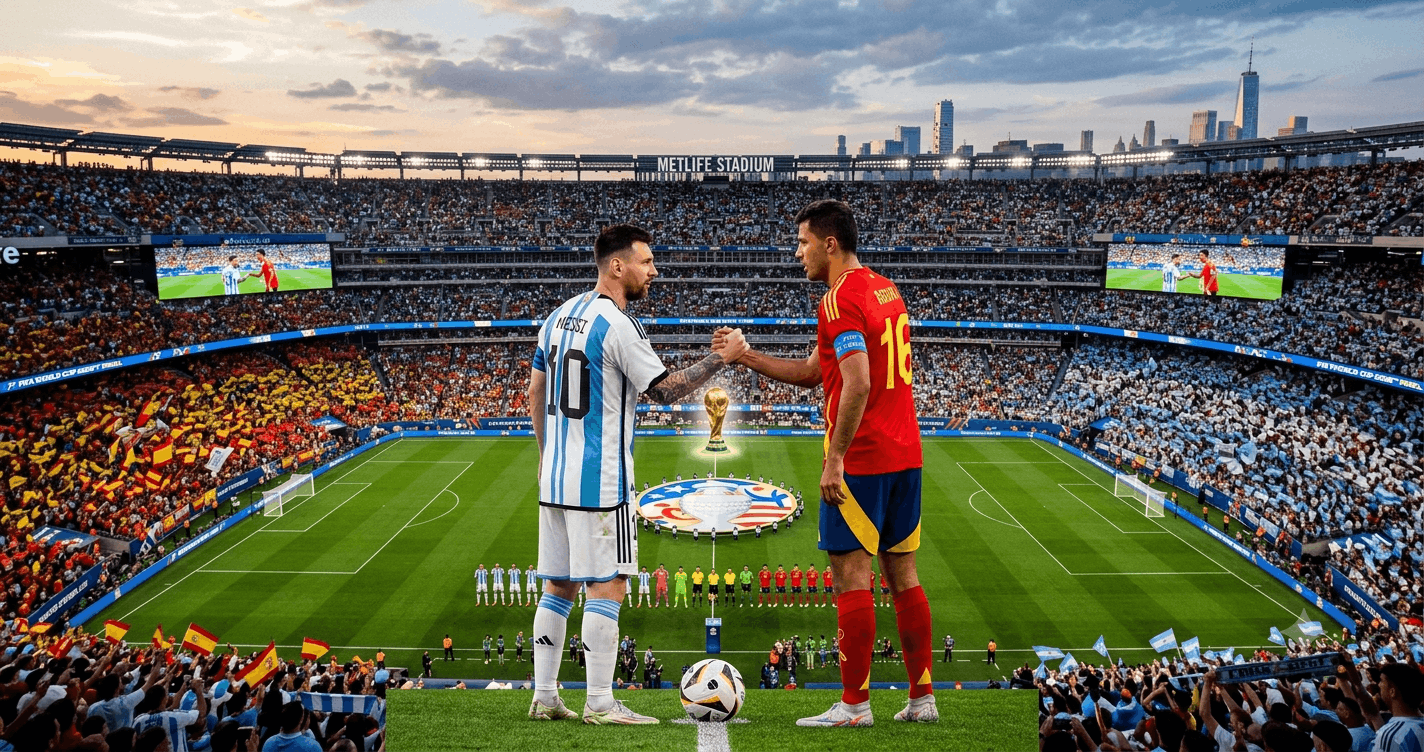
The journey began with forty-eight nations, spanned three vast host countries, and delivered some of the most chaotic, beautiful, and heart-stopping football ever witnessed. Now, after 103 matches of relentless drama, the 2026 FIFA World Cup arrives at its ultimate destination: East Rutherford, New Jersey. On Sunday, July 19, 2026, the world will grind to a halt as Spain and Argentina step onto the grass of MetLife Stadium to write the final, defining chapter of this historic tournament.
This is not merely a football match; it is a clash of deeply rooted sporting cultures, identities, and philosophies. On one side stands La Roja, a team that has redefined modern football over the last two years. Under the calm guidance of Luis de la Fuente, Spain has discarded the sterile, endless sideways passing of the past and built a hyper-efficient, vertical, and terrifyingly young attacking machine. On the other side stands La Albiceleste, the defending champions of the world, fueled by an emotional, almost spiritual quest to hand the greatest player of all time, Lionel Messi, a glorious, back-to-back golden farewell.
Matchday Guide
| Category | Details |
|---|---|
| Fixture | Spain (ESP) vs. Argentina (ARG) |
| Kickoff Time | 3:00 PM Local (EST) / 8:00 PM BST / 12:45 AM NST (Monday) |
| Venue | MetLife Stadium (New York New Jersey Stadium), East Rutherford, NJ |
| Spain's Path | 1st in Group A, def. Switzerland (R32), USA (R16), Portugal (QF), France (SF) |
| Argentina's Path | 1st in Group C, def. Cape Verde (R32), Ecuador (R16), England (QF), Brazil (SF) |
Spain: The Flawless Machine
Nobody has been able to lay a glove on Spain during this tournament. Coming off their Euro triumph, Luis de la Fuente’s squad has operated with the cold, ruthless efficiency of a supercomputer. While historical Spanish teams prioritized possessing the opposition to death—often racking up 1,000 passes without a shot—this generation plays with verticality, physical power, and breathtaking pace.

The driving force behind this evolution has been the wing duo of Lamine Yamal and Nico Williams. Yamal, playing with a wisdom that defies his teenage years, has been the creative architect on the right wing, cutting inside to slide incisive balls through defensive lines. On the opposite side, Nico Williams has terrorized full-backs with his raw, explosive acceleration and direct running.
Stat of the Tournament
Spain has played 540 minutes of football in the knockout rounds of this World Cup and has never trailed for a single second. They have conceded only one goal—a deflected strike in their 2-0 win over France—while scoring 16 times.
Anchoring this terrifying engine room is Rodri. The Manchester City midfielder has acted as Spain’s tactical heartbeat, recovering loose balls, dictating the tempo of possession, and completely neutralizing opposing transitions. Because of Rodri's positioning, Spain’s defense has rarely been exposed, protecting the center-back pairing of Aymeric Laporte and Robin Le Normand from having to defend in open space.
Their semifinal victory over a defensively stubborn France was a masterclass in control. Spain took an early lead, choked French counter-attacking lanes, and casually kept possession in the second half to stroll into the final. They look physically fresh, tactically absolute, and entirely ready to reclaim the throne they last occupied in 2010.
Argentina: The Inevitables
While Spain has glided through the tournament with supreme ease, Argentina has clawed, fought, and bled for every single yard. If Spain represents the beauty of structure, Lionel Scaloni's Argentina represents the beauty of survival. This is a team forged in fire, comfortable in the chaos, and absolutely convinced that they are destined to lift the trophy once again.
Their campaign has been a theatrical masterpiece. After comfortably winning their group, Argentina faced a massive scare in the Round of 32 against a spirited Cape Verde side, finding themselves tied 2-2 in extra time before a 118th-minute breakthrough. In the quarterfinals, they stood toe-to-toe with England in a physical battle, surviving late English pressure to win 2-1. In the semifinals, they faced rivals Brazil in an emotionally charged Superclásico, where a piece of pure magic from Lionel Messi set up Julián Álvarez for the match-winning goal.
The Late-Show Specialists
No lead is safe, and no deficit is permanent against La Albiceleste. Out of Argentina's 19 goals in the tournament, a staggering 12 have been scored after the 75th minute. They simply refuse to be defeated when the pressure is at its peak.
At 39 years old, Lionel Messi is no longer sprinting for 90 minutes, but his influence on the game has never been more profound. Playing in a deep playmaker role, Messi orchestrates the Argentinian attack with surgical precision. When he gets the ball, the stadium holds its breath. Surrounding him is a midfield of tireless workhorses—Rodrigo De Paul, Enzo Fernández, and Alexis Mac Allister—who run themselves into the ground to afford Messi the luxury of walking, scanning, and striking at the perfect psychological moment.
Behind them stands the tournament's ultimate antagonist: goalkeeper Emiliano "Dibu" Martínez. The Aston Villa shot-stopper has once again proven to be Argentina’s spiritual savior, pulling off massive, tournament-saving stops and acting as the defensive anchor of a team that thrives when their backs are against the wall.
Tactical Breakdown: How the Final Will Be Won
A World Cup final is rarely decided by talent alone; it is decided by space, timing, and structural adaptation. Here are the three tactical battlegrounds that will dictate who lifts the trophy in New Jersey.
1. Controlling the Half-Spaces
Spain operates with a very high defensive line to keep their team compact. This allows them to counter-press aggressively the moment they lose the ball. However, this high line is highly vulnerable if the opponent has a passer who can exploit the space behind the center-backs.
Argentina’s primary objective will be to bypass Rodri and find Messi in the pocket of space just in front of Spain's central defenders. If Rodrigo De Paul can win second balls in midfield and quickly transition the ball to Messi, the legendary number 10 will have the time to slide defense-splitting passes to the bursting runs of Julián Álvarez and Lautaro Martínez.
2. The Battle of the Flanks
How does Lionel Scaloni plan to stop Spain's lethal wing play? Left-back Nicolás Tagliafico and right-back Nahuel Molina will have the hardest jobs of their lives.
Argentina is likely to employ a defensive system that doubles down on the wings. We can expect midfielders like Mac Allister and De Paul to constantly drift wide to support their full-backs, attempting to isolate Yamal and Williams in 2-on-1 situations. If Argentina can lock down the wide channels, Spain will be forced to play through the congested center of the pitch, where Argentina's physical defensive block is most comfortable.
3. The Bench and Game Management
Given the extreme summer heat of July and the high physical toll of both teams' playing styles, the second half will be a war of attrition.
Spain boasts immense depth with the likes of Dani Olmo and Mikel Oyarzabal capable of coming off the bench to inject fresh energy into the press. Argentina, on the other hand, has dynamic game-changers like Alejandro Garnacho and Enzo Fernández who can alter the tempo of a match. Scaloni’s ability to manage his substitutions will be vital, especially if the match extends into a grueling extra-time period.
Key Head-to-Head Duels
Lamine Yamal vs. Nicolás Tagliafico
The 19-year-old Spanish prodigy against the veteran battle-hardened Argentinian defender. Tagliafico’s positioning and defensive discipline will be severely tested by Yamal's acceleration and ability to cut inside onto his favored left foot. If Yamal dominates this flank, Spain will break Argentina's defensive block apart.
Rodri vs. Rodrigo De Paul
The engine room battle. Rodri is the brain of Spain's system, while De Paul is the heart of Argentina's midfield. De Paul’s primary mission will be to disrupt Rodri, break his passing rhythm, and physically intimidate the Spaniard. It’s a classic duel between tactical elegance and raw, relentless aggression.
Aymeric Laporte vs. Lionel Messi
Laporte has been exceptional in organizing Spain's backline, but defending Lionel Messi is an entirely different puzzle. Laporte cannot afford to drop too deep, or Messi will shoot from range; if he steps up too aggressively, he risks leaving gaping holes behind him for Julián Álvarez to exploit.
The Ghost of Qatar and the Pursuit of Immortality
Four years ago in Lusail, Lionel Messi completed football. He lifted the elusive gold trophy, filled the only empty space in his cabinet, and assumed his undisputed place atop the footballing pantheon. Most expected him to ride off into the sunset.
Instead, he stayed. He conquered MLS with Inter Miami, maintained his physical peak, and returned to lead his country one final time on the North American stage. The narrative surrounding Argentina is fueled by the romantic, powerful collective desire of a squad of players who grew up watching Messi on television and are now prepared to die on the pitch to ensure he retires on the absolute peak of the world.
But Spain does not care about fairy tales. This young Spanish squad, led by players who were toddlers when Spain won their first World Cup in 2010, wants to establish their own dynasty. Winning a European Championship in 2024 and a World Cup in 2026 would put this Spain side in the conversation with the legendary 2008-2012 generation as one of the greatest national teams to ever play the game.
The Prediction: Destiny or Design?
On paper, Spain is the superior team. They have played the better football, possess a more balanced starting eleven, and have a structural defense that has proven almost impossible to break down. If this match were played inside a computer simulation ten times, Spain would win eight of them.
But World Cup finals are not played on spreadsheets. They are played in pressure-cooker atmospheres, filled with tension, mistakes, and moments of individual genius that defy mathematical logic. Argentina knows how to suffer, how to win ugly, and how to harness the immense energy of their traveling fans.
We expect a match of incredible tactical discipline. Spain will dominate possession, probing the Argentinian low-block with patience and speed. Argentina will bide their time, waiting for the singular mistake that allows Messi to unleash chaos. It has all the ingredients of an all-time classic that could go all the way to the dramatic theater of a penalty shootout.
Join the Discussion
Will Spain's flawless structural design dismantle the champions, or will Lionel Messi's final script write one last golden page in football history? Let us know your score predictions below!
 How to Compare Football Teams Using Recent Form, Goals and Home-Away Records
 Lumbini Lions Roar into NPL Season 3 with Dominant Victory Over Sudurpaschim
 Sports Management Software in 2026: One Platform for Players, Coaches and Federations
 Mbappe Brace Sinks Barcelona in El Clásico Thriller
 DRS and AI Technology Set to Revolutionize Nepal Premier League
 NPL Season 3 Kicks Off: Lumini Lions Face Sudurpaschim Royals in Highly Anticipated Opener
 Premier League Shocker: Manchester City and Chelsea Stumble as Arsenal and Tottenham Triumph
Comments
0Log in to join the conversation.
Writer loginNo comments yet. Be the first to respond.