
Why the 2026 World Cup is Football’s Ultimate Stress Test
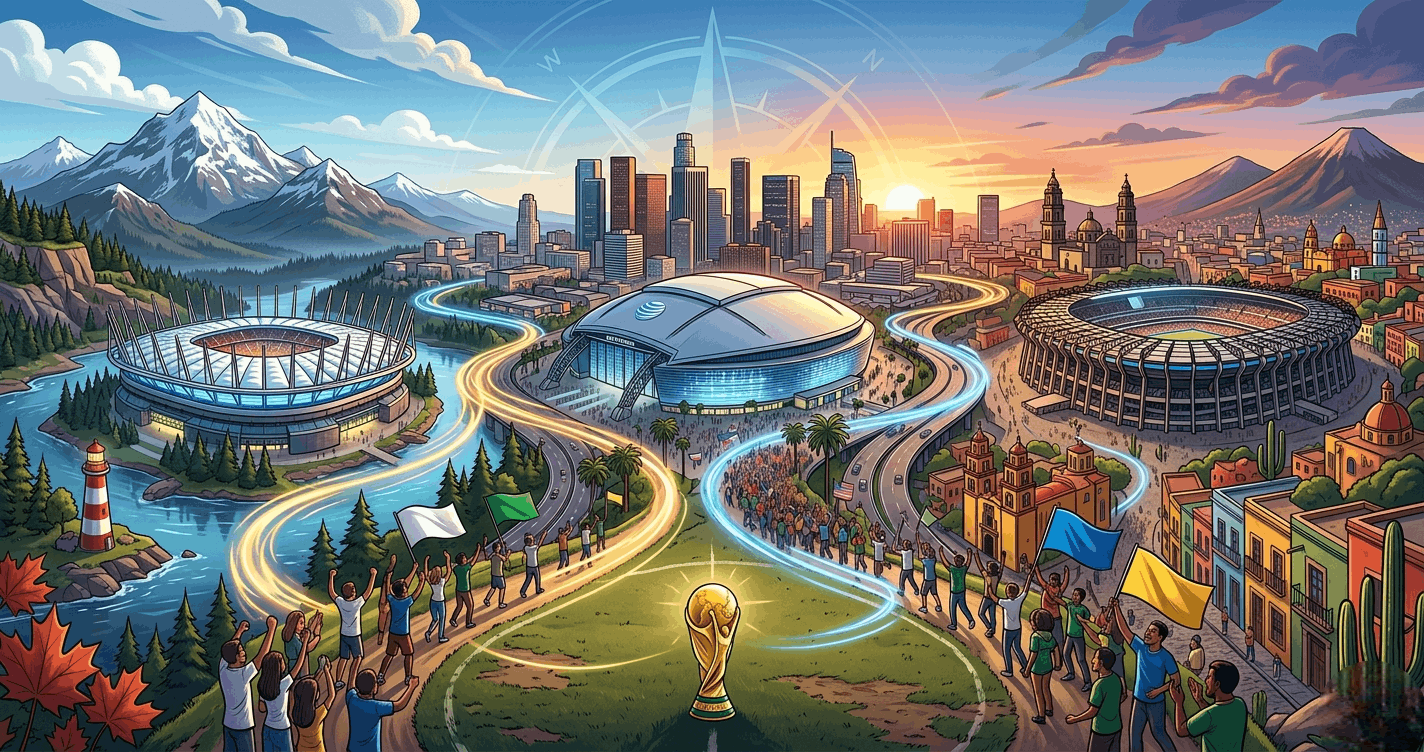
We have all swallowed the corporate liturgy surrounding the FIFA World Cup 2026. We know the commercial catechism by heart: it is the "biggest ever," an "unprecedented festival of North American unity," a commercial leviathan comprising 48 teams, 3 host nations, and a dizzying 104 matches sprawling across 39 high-octane days.
But if you scrape away the candy-coated promotional varnish applied by FIFA and its corporate ecosystem, a far more complex, eerie, and brilliant reality reveals itself. The 2026 World Cup is not merely an expanded iteration of your favorite quadrennial football tournament. It is a fundamental mutation of the sport's structural DNA. It represents the death of the localized, hyper-focused sports tournament and the birth of a decentralized, cross-continental, hyper-mobile simulation of athletic endurance.
Welcome to the era of the World Cup as a Border-Fluid Stress Test—a tournament defined less by traditional tactical genius and more by circadian biology, microclimatic adaptation, and the sheer logistical mastery of human cargo.

I. The Death of the "Comfortable" Group Stage and the Rise of Aggressive Goal-Hoarding
For nearly three decades, the 32-team World Cup format provided a deeply satisfying, narrative symmetry. It was a beautiful, predictable chess match: eight groups of four, top two advance, bottom two pack their bags. You had exactly three matches to discover your identity, adjust your tactical pivot, and mathematically guarantee survival. If a powerhouse side stumbled into a shock defeat on Matchday 1, they still possessed a spacious runway to realign their trajectory on Matchdays 2 and 3. Winning two matches almost universally punched your ticket to the knockout rounds.
The expansion to 48 teams—manifested through 12 groups of four teams—wrenches this security blanket away, replacing it with an anarchic system where the margin between triumph and humiliation is razor-thin. Because the top two teams from each group plus the eight best third-placed teams will now scramble into a brand-new, terrifying Round of 32, the group stage undergoes a profound psychological transformation.
The Math of the Margin
In the new 48-team infrastructure, 32 out of 48 teams will survive the opening salvo. This means 66.6% of the field advances. While this sounds forgiving on paper, it introduces a volatile variable: the manic optimization of Goal Difference.
Under this mathematical regime, the concept of the "dead rubber"—that sleepy third group match where qualified teams rest their superstars and eliminated teams play for nothing but pride—is completely dead. A team entering Matchday 3 with zero points and a devastating -4 goal difference is no longer mathematically dead; they are merely one chaotic, highly volatile 3-0 victory away from sneaking into the Round of 32 as a lucky third-place survivor.
Consequently, we must prepare ourselves for the era of ruthless, systemic, unyielding goal-hoarding. When a traditional footballing superpower like France, Argentina, or Germany finds themselves leading a debutant nation like Oman, Uzbekistan, or New Zealand by three goals in the 75th minute, the historic protocol was to slow the tempo, retain possession, conserve energy, and shield legs from cynical tackles. In 2026, that luxury vanishes. Managers will frantically gesture from the technical areas, demanding a fourth, fifth, and sixth goal. Every single strike is a precious unit of insurance against the invisible, multi-group matrix of third-placed teams. The group stage will no longer feel like an elegant build-up; it will look like a frantic, gold-rush stampede where teams hunt lopsided scorelines with predatory desperation.
II. The True Antagonists: Circadian Rhythms, Jet Lag, and Biome Disruption
When tactical analysts discuss how to win a World Cup, they inevitably obsess over tactical formations: low-blocks, high-pressing triggers, inverted full-backs, and transitions within the half-spaces. But in 2026, the primary arbiter of footballing destiny will not be found on a tactical whiteboard. It will be found in the sports science laboratory, specifically calculated by logistics coordinators managing the physiological toll of multi-biome transit.
The 16 host cities of the 2026 World Cup do not constitute a single tournament environment; they represent an archipelago of distinct ecological, meteorological, and geographic realities spread across three time zones. Consider the sheer physical violence inflicted upon an athlete's body by the following plausible tournament itinerary:
| Stage | City / Venue | Altitude / Climate | Physiological Impact |
|---|---|---|---|
| Match 1 | Vancouver (BC Place) | Sea Level / Cool coastal air | Standard aerobic threshold, high-intensity sprinting sustained. |
| Match 2 | Houston (NRG Stadium) | Sea Level / Extreme humidity (Indoor dome) | Accelerated dehydration, profound sweat-rate spikes, muscle cramping. |
| Match 3 | Mexico City (Estadio Azteca) | 7,200+ Feet / Hypoxic High Altitude | 30% reduction in oxygen saturation, immediate VO2 max drop, severe lung burn. |
In traditional tournaments, teams anchored themselves in a centralized base camp. In Russia (2018) or Brazil (2014), despite the vast geographic footprints of those nations, teams carefully engineered a single home-away-from-home base, flying out the day before a match and returning immediately to an identical climate and bed. Qatar (2022) was a hyper-localized extreme, functioning essentially as an Olympic Village where teams didn't even need to board a plane for the duration of the tournament.
In 2026, that luxury is vaporized. Despite FIFA’s earnest promises to "regionalize" the group stages into West, Central, and East clusters to minimize travel, the knockout rounds will systematically force teams into cross-continental flight paths. A squad could theoretically find themselves playing a Round of 32 clash in the damp chill of Seattle, flying four hours to the sweltering afternoon humidity of Miami for the Round of 16, and then pivoting back to the thin, breathless air of Mexico City for a quarter-final.
This constant re-calibration of the human body destroys the traditional baseline of athletic performance. When oxygen availability fluctuates wildly from one week to the next, when players are forced to continually adjust their internal clocks by three hours every four days, sleep architecture breaks down. When deep sleep is compromised, human growth hormone production drops, cortisol spikes, and muscle tissue recovery slows to a crawl.
The teams that survive this gauntlet will not necessarily be the ones possessing the most mesmerizing tactical identity or the highest concentration of elite individual virtuosos. Instead, the trophy may well belong to the nation that boasts the most sophisticated sports-science infrastructure—the ones utilizing advanced hyperbaric chambers, cryotherapy optimization, customized compression garments, and meticulous, algorithmic squad rotation. The traditional 11-man starting lineup is officially dead; in 2026, the bench is transformed from a collection of contingency options into a vital organ of physiological survival.
III. The Chaos Vector: The Unforgiving Tyranny of the Round of 32
By expanding the tournament format, FIFA has done something far more insidious than merely adding more games; they have introduced a massive, volatile "Chaos Vector" by inserting an entire extra knockout tier: the Round of 32.
Historically, navigating the group stage of a World Cup felt like climbing a well-constructed staircase. Once you emerged into the Round of 16, you entered an elite, rarefied atmosphere. The tournament became a highly predictable, high-prestige affair where footballing aristocrats faced off in games decided by subtle tactical adjustments. Underdogs occasionally broke through, but they were usually exhausted, emotionally spent, and easily dispatched by the giants.
"The insertion of the Round of 32 flattens the footballing hierarchy completely. It morphs the tournament from a structured test of class into an unpredictable single-elimination lottery a full week earlier than ever before."
Consider the structural mechanics of a one-off, 90-minute knockout match involving a powerhouse team that has spent the previous two weeks traversing thousands of miles across different time zones, arriving with heavy legs and compromised sleep. Now, place them on a pitch against a highly disciplined, hyper-defensive underdog that scraped into the knockout bracket by finishing as the 8th best third-placed team.
This underdog has nothing to lose. They haven't spent the group stage exhausting themselves trying to dominate possession; they have sat in a low-block, choked the spaces, and ground out two ugly draws and a narrow win. They are fresh, single-mindedly focused, and perfectly content to drag the footballing superpower into a miserable, suffocating war of attrition.
If that match remains tied after 90 minutes, there is no extra time in the early knockout rounds to let class and depth eventually prevail—it goes straight to the agonizing, heart-stopping lottery of a penalty shootout. The Round of 32 is a giant, structural equalizer designed to generate shocking institutional casualties. In 2026, we will inevitably witness at least two or three authentic tournament favorites—teams built to win the entire competition—bundled out in the first knockout round by teams that wouldn't have even qualified for a traditional 32-team tournament. The margin for error has not just shrunk; it has been completely obliterated.
IV. The Commercialized Spatial Disconnect: Stadiums as Monolithic Corporate Embassies
To understand the unique soul—or lack thereof—of the 2026 World Cup, one must examine its physical cathedrals. This tournament marks the complete sublimation of local footballing culture into the generic, ultra-premium language of modern North American stadium architecture.
When the World Cup traveled to footballing heartlands like Germany in 2006 or Italy in 1990, the stadiums were deeply woven into the historic urban fabric of their respective cities. They were monuments to local club rivalries, stained with decades of domestic terraces, smoking flares, and generational neighborhood identities. Even when stadiums were heavily renovated, they retained their gritty, regional specificity.
In 2026, the dominant venues are massive, billion-dollar NFL coliseums: AT&T Stadium in Dallas, SoFi Stadium in Los Angeles, Mercedes-Benz Stadium in Atlanta, and New York New Jersey Stadium (MetLife) in East Rutherford. These structures are marvels of civil engineering, but they do not belong to the cities they inhabit; they belong to the stratosphere of global corporate hospitality. They are corporate embassies wrapped in glass, LED screens, and premium luxury suites.
This creates a fascinating, almost surreal spatial disconnect for the traveling global fan. When an English fan, a Moroccan fan, or a Japanese fan arrives at an NFL stadium located in a vast sea of asphalt parking lots miles outside a city center, they are not entering a traditional footballing cauldron. They are stepping into a climate-controlled, multi-tiered entertainment machine designed primarily to maximize per-capita spending.
The Pitch Engineering Challenge
Most of these mega-venues utilize artificial turf for gridiron football. Because FIFA strictly mandates natural grass, millions of dollars have been spent laying temporary, modular grass surfaces over concrete or turf foundations. These retrofitted pitches lack deep root systems, meaning the turf will inevitably cut up, shift, and degrade under the stress of rapid directional changes, directly altering the speed and cadence of the matches.
This architectural reality alters the acoustic and emotional landscape of the tournament. The deep, rolling, tribal chants that define European and South American terraces will find themselves swallowed by the immense, echoing cavernous voids of these massive indoor domes. The spectacle will be hyper-polished, perfectly lit for 4K broadcast television, and meticulously produced, but it will feel distinctly decoupled from the traditional, localized romance of the sport. It is football operating within a simulated space—the stadium as an island of corporate sovereignty floating over a sea of North American infrastructure.
V. The Micro-Narratives of the Fringe: A Democratic Carnivalesque
It is easy to look at this expanded infrastructure and sink into a cynical, purist despair. It is undeniably true that expanding the tournament to 48 teams dilutes the absolute technical density of the event. During the initial weeks of the group stage, we will undoubtedly be forced to sit through lopsided, uninspired encounters where global heavyweights casually dismantle under-resourced debutants who have qualified through expanded continental allocations.
Yet, if we shift our perspective away from the elitist obsession with immaculate tactical purity, a beautiful, democratic alternative emerges. The 2026 World Cup is a celebration of the footballing fringe. It is a sprawling, chaotic canvas that grants nations that have spent nearly a century locked outside the gates of the global party a legitimate seat at the table.
For a nation that has never tasted the intoxicating, unifying madness of a World Cup qualification, simply being present changes everything. It alters domestic sporting infrastructure, inspires a generation of young children to lace up boots, and forces a country's political and social collective to focus intensely on a single ball for 270 minutes.
The true romance of this tournament will not be found in the familiar, corporate-packaged narratives of superstars chasing individual awards. It will be found in the brilliant, unscripted micro-stories unfolding in the margins:
- A semi-professional fullback from an unheralded qualifying nation executing a perfect, clean slide-tackle on a $150 million superstar forward in front of 80,000 screaming fans.
- A traveling contingent of 10,000 passionate fans from a debutant country turning a suburban American parking lot into a vibrant, swirling, joyous carnival of food, music, and tears of pure disbelief.
- The absolute, unadulterated ecstasy of a nation scoring its first-ever World Cup goal in the 88th minute of a match they are losing 4-1—a goal that will be replayed in that country for the next fifty years.
By expanding the map, FIFA has democratized the collective trauma and joy that only this tournament can manifest. It transforms the World Cup from an exclusive, closed-shop European and South American country club into a genuinely global, carnivalesque mirror of humanity.
VI. Conclusion: The Survival of the Most Adaptable
When the final ball is kicked on July 19 at New York New Jersey Stadium, the team hoisting the golden trophy will have achieved something far grander than any of their historic predecessors. To win the 2026 World Cup, a squad must survive a brutal, multi-continental gauntlet that tests every single parameter of human endurance and structural resilience.
They must survive 104 matches of collective national anxiety. They must conquer the tactical anarchy of an expanded group stage where goal-hoarding is a necessity. They must outlast the physiological violence of jumping across three time zones, three countries, and three completely different climatic biomes. They must successfully dodge the sudden-death landmines buried throughout a ruthless, expanded Round of 32 knockout matrix.
It will not be the prettiest World Cup ever played. It will be loud, chaotic, exhausting, monetarily rapacious, and occasionally messy. Traditional tactical structures will inevitably buckle and break under the sheer weight of travel fatigue, dehydration, and desperation. But that structural fragility is precisely what makes it compelling. We are no longer merely watching a football tournament; we are witnessing the ultimate, border-fluid survival test of the modern elite athlete.
Welcome to the 104-act opera. Grab your spreadsheet, pack your hydration tablets, and embrace the beautiful, untamed madness.
 Decoding Cricket Analytics: How Fans Analyze Match Odds and Team Trends
 The Boy from Pujali Who Dreamed of the Big Stage—Why Did Mahroos Siddiquee Nadim’s Career Hit a Question Mark?
 Live Cricket Score, Matches & Updates | Sports Live Hub
 Cricket Blog 2026 – Latest Cricket News, Match Analysis, Stats & Sports Guides | BJ Sports
 How to Compare Football Predictions and Match Tips
 WEBSITES 2026 FOR FOOTBALL FIXED MATCHES TIPS
 How Modern Cricket Analytics Is Changing the Way Teams Win Matches
Comments
0Log in to join the conversation.
Writer loginNo comments yet. Be the first to respond.