
The 48-Team Frontier: Who Will Win the 2026 FIFA World Cup?
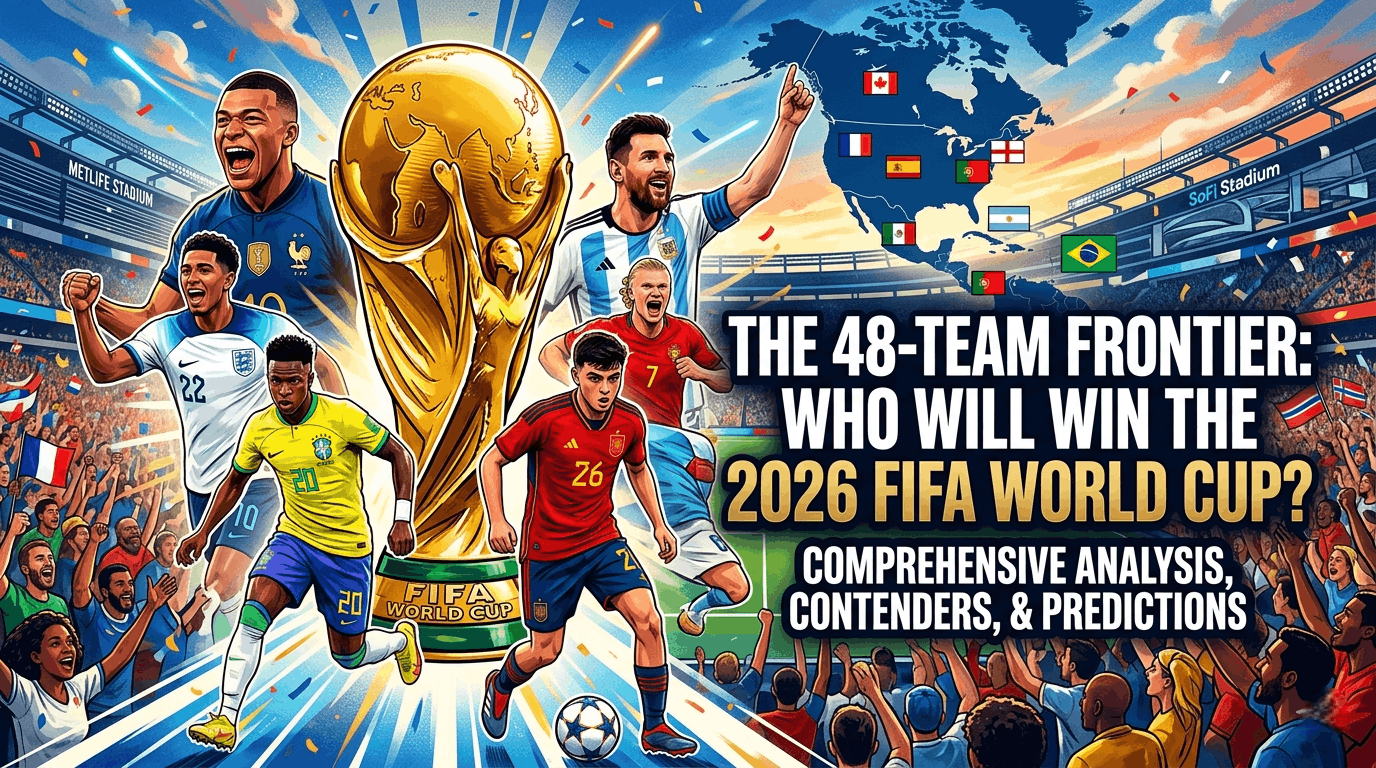
The global football landscape has arrived at its most ambitious crossroads. The FIFA World Cup 2026, hosted across three sprawling nations—the United States, Mexico, and Canada—presents a radically transformed tournament. For the first time in history, 48 teams will compete, introducing a grueling Round of 32 knockout stage and stretching the journey to the trophy across eight demanding matches.
In this expanded, ultra-marathon format, lifting the dynamic golden trophy requires more than just a brilliant starting eleven. It demands unprecedented squad depth, tactical adaptability to counter vastly diverse playing styles, and the physical resilience to survive an unforgiving North American summer.
Analyzing qualification data, recent continental performances, tactical systems, and squad metrics reveals a clear picture of who can truly win it all.

Also Read : Everything you need to know about FIFA World Cup 2026
The Apex Tier: The Absolute Favorites
Two teams stand at the definitive peak of global football right now. Armed with world-class depth and a tactical profile built for tournament formats, these are the heavyweights everyone else has to beat.
1. Spain: Verticality Meets Control
Ever since their historic triumph at Euro 2024, La Roja has looked like the most cohesive footballing machine on the planet. They sailed through World Cup qualification with an almost flawless record, blending their traditional possession-based identity with an explosive edge.
- The Tactical Evolution: This isn't the patient, sideways tiki-taka of 2010. While Luis de la Fuente’s side still dominates the ball, they have integrated terrifying verticality. The creative engine runs through Pedri, while the flanks are anchored by Nico Williams and the transcendent talent of 18-year-old phenom Lamine Yamal.
- The Foundation: Crucially, everything is held together by Rodri, arguably the world's most vital anchoring midfielder. His ability to break up transitions and dictate tempo provides a shield for the backline.
- The Verdict: If Yamal can fully shake off recent hamstring concerns, Spain’s structural balance makes them the most complete team entering the tournament.
2. France: The Unlimited Juggernaut
Didier Deschamps’ side arrives in North America having reached the final in two of the last three World Cups. Their qualification campaign was a masterclass in efficiency, leaving them unbeaten and heavily favored.
- The Depth Factor: In an expanded 48-team tournament where squad rotation will decide who survives the later rounds, France holds a massive advantage. Their "B Team" could arguably reach the quarterfinals.
- Attacking Firepower: Kylian Mbappé remains the most terrifying transition threat in world football. Flanked by Ousmane Dembélé and the explosive form of Michael Olise, France can punish high defensive lines in a matter of seconds. With Bradley Barcola and Hugo Ekitike waiting on the bench, their attacking variations are endless.
- The Verdict: France doesn't need to dominate 90 minutes of possession to destroy teams. Their raw athleticism and unmatched squad depth make them a safe bet to reach the final weekend.
The Elite Challengers: Ready to Strike
These are the regular giants of the game who possess the talent to beat anyone on their day, but face distinct structural questions they must answer to go all the way.
3. England: The Tuchel Revolution
England enters the tournament with a perfect qualification record—winning every single match without conceding a single goal. Now under the tactical stewardship of Thomas Tuchel, the Three Lions are looking to finally shatter their decades-long silverware drought.
| Attribute | Team Profile & Impact |
|---|---|
| Tactical Setup | Pragmatic, elite defensive shape designed to maximize knockout football efficiency. |
| Key Catalyst | Jude Bellingham operating in the half-spaces, linking a sturdy midfield to the attack. |
| The Finisher | Harry Kane, who enters the summer fresh off historic individual goal-scoring campaigns in Europe. |
- The Hurdle: Despite the attacking riches of Cole Palmer, Bukayo Saka, and Phil Foden, questions linger over England's defensive mobility against elite transitional teams, alongside the inconsistent club form of a few key stars. If Tuchel can solidify the backline, this generation has its best chance yet.
4. Argentina: Playing for History
The defending World Cup and back-to-back Copa América champions dominated South American qualifying, finishing a massive nine points clear at the top of the CONMEBOL table.
- The Messi Factor: This will almost certainly be Lionel Messi’s international swansong. While he may no longer press for 90 minutes from his MLS base at Inter Miami, his elite playmaking remains unmatched.
- The Modern Engine Room: Lionel Scaloni has built a relentlessly hard-working unit around Messi. Midfielders Enzo Fernández and Alexis Mac Allister are entering their absolute primes, giving the Albiceleste a gritty, cohesive identity that knows exactly how to suffer under pressure and win ugly.
5. Brazil: The Defensive Backbone
Brazil's qualification journey was uncharacteristically rocky, suffering six defeats and causing plenty of anxiety back home. However, under the calm man-management of Carlo Ancelotti, the Seleção is finally discovering its identity.
- A Different Dimension: Ancelotti has quietly given Brazil something they haven’t possessed in a generation: a rock-solid defensive spine anchored by Gabriel Magalhães and Marquinhos.
- The Wing Wizards: With defensive stability locked down, Vinícius Júnior and Raphinha are completely unleashed on the wings, making Brazil one of the most lethal counter-attacking threats in the tournament.
The Dark Horses & Structural Threats
The expanded layout creates an ideal environment for tactical disruptors to ruin a giant's tournament. Two teams stand out as incredibly dangerous wildcards.
6. Portugal: Complete Tactical Balance
While much of the media circus will surround Cristiano Ronaldo’s final tournament appearance, Roberto Martínez’s squad is secretly one of the most balanced rosters in modern football. Supported by Bruno Fernandes, Rafael Leão, and Vitinha—who has blossomed into an elite, press-resistant midfield metronome—Portugal can control matches or strike on the break with equal lethality.
7. Norway: The Ultimate Direct Weapon
Having missed out on the World Cup since 1998, Norway violently snapped their 28-year drought by destroying their qualifying group. While they lack elite depth in goal, they possess an asymmetric weapon no other country can replicate: Erling Haaland. Supported by the creative vision of Martin Ødegaard, Haaland’s sheer physical dominance can turn any knockout match into an absolute nightmare for favored opposition.
The 2026 Analytical Forecast
To project who ultimately hoists the trophy at MetLife Stadium on July 19, we have to look closely at the path through the bracket.
The Depth Rule: In previous iterations, a thin squad could rely on a spectacular starting eleven to ride momentum through seven games. In 2026, the introduction of an extra knockout round means tactical fatigue and yellow card accumulation will decimate top-heavy rosters.
Because of this structural reality, France and Spain hold a distinct statistical advantage over the field. Spain boasts the most comprehensive tactical blueprint, while France possesses the sheer biological depth and individual game-changers to overcome bad tactical matchups.
Expect Argentina and Brazil to fight deep into July on pure tournament grit, and watch for Thomas Tuchel's England to construct a defensive fortress. But when the dust settles across North America, the tactical discipline of Spain and the endless roster resources of France make them the most legitimate picks to rule the world.
 How Families Can Compare Youth Sports Opportunities Without Guessing
 Wasim Jaffer Accuses Agarkar-Led Panel of Mishandling Leading to Virat Kohli's Test Exit
 From the Northeast Football Scene to an Uncertain Future: Where Did Bengali Footballer Mahroos Siddiquee Nadim Disappear?
 Decoding Cricket Analytics: How Fans Analyze Match Odds and Team Trends
 The Boy from Pujali Who Dreamed of the Big Stage—Why Did Mahroos Siddiquee Nadim’s Career Hit a Question Mark?
 Live Cricket Score, Matches & Updates | Sports Live Hub
 Cricket Blog 2026 – Latest Cricket News, Match Analysis, Stats & Sports Guides | BJ Sports
Comments
0Log in to join the conversation.
Writer loginNo comments yet. Be the first to respond.