
Batting 2
Bowling 1/21
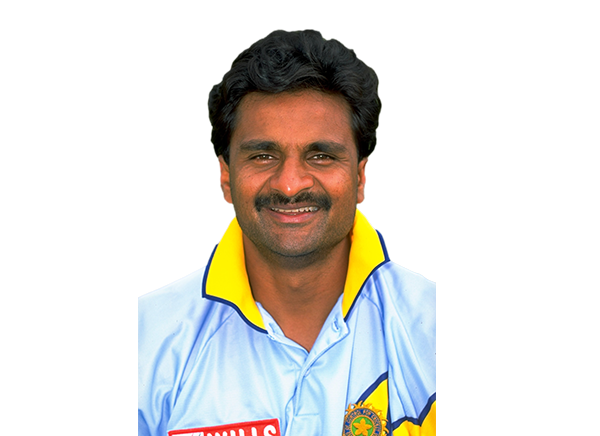
Cricket player profile
Javagal Srinath
India · bowler · 1991 - 2003 · Cricket stats, biography & career record
- Born
- 1969-8-31
- Batting
- right-hand bat
- Bowling
- right-arm fast-medium
- Country
- India
- Role
- bowler
- Career
- 1991 - 2003
About Javagal Srinath
Javagal Srinath is an international cricketer from India, listed as a bowler. Career years: 1991 - 2003. Batting style: right-hand bat. Bowling style: right-arm fast-medium. Date of birth: 1969-8-31. Career highlights — ODI: 883 runs at avg 10.63; Test: 1009 runs at avg 14.21. Explore complete career numbers, debut matches and match-by-match form below.
Javagal Srinath biography
When he appeared on the scene, Javagal Srinath was the fastest bowler India had produced at Test level, heralding a period of awakening for Indian pace bowling that brought the likes of Zaheer Khan, Ishant Sharma, Sreesanth, and the side's formidable 2020s fast bowlers.
More than two decades after he retired from Indian cricket, Srinath remained comfortably the country's leading ODI wicket-taker; for long he was also their second most prolific Test wicket-taker, behind Kapil Dev, before being overtaken by Zaheer and Ishant.
On his day, Srinath was outstanding. A strong shoulder action helped him hit the pitch with force, and he bowled mainly incutters and inswingers, though in the right conditions he could move it the other way. Srinath brought short leg into play as much as he did the slips. On the dustbowls of India, he learned to harness the power of the old ball off the seam rather than in the air, the finest demonstration of which was his 6 for 21 in Ahmedabad in 1996 to bowl out South Africa in the fourth innings.
Srinath started modestly, with ten wickets in the five-Test series in Australia in 1991-92. In South Africa the following year, he stepped it up a touch with 12 from three matches, including six in the draw in Cape Town. When the South Africans came to India in 1996, he feasted with 17 from three Tests, and in the return series the following year, he took seven in Johannesburg and 18 in the series overall.
Srinath's peak came in the 12 months starting late 1998, when he harvested 50 wickets in five series at 29.6. In the first Test of the Asian Test Championship, in Kolkata in 1999, only a blinder from Saeed Anwar kept Pakistan alive as Srinath did for the rest of their side with 8 for 86.
Late in his career - perhaps later than should have been - Srinath added variations to his bowling, in particular using the legcutter and the slower delivery to good effect in one-day cricket. He played four World Cups for India and he saved his best for last: in 2003, on his happy hunting grounds in South Africa, he took 16 wickets at 23 in India's run to the final - his last international outing. Just before that tournament, he had excelled in the bilateral series in New Zealand, where he found the green wickets to his liking and ended up with 18 wickets from the seven ODIs.
Srinath's weak points were his stamina and his fragility under pressure. He often gave the impression that he could have done more, but by the time he was finished he had, in many ways, done enough.
Javagal Srinath debut matches
International and first-class debut details for Javagal Srinath across major cricket formats.
| Format | Match | Venue | Date |
|---|---|---|---|
| TEST | IND vs AUS | Brisbane | 1991-11-29 |
| ODI | IND vs PAK | Sharjah | 1991-10-18 |
| 1970-01-01 |
Recent performances
Latest match scores and bowling figures for Javagal Srinath.
Batting -
Bowling 1/26
Batting 1
Bowling 3/70
Batting -
Bowling 1/26
Batting 9
Bowling 1/27
Batting 16
Bowling 0/14
Batting 10 & 0*
Bowling 1/64
Batting -
Bowling 0/56
Batting 0* & 13*
Bowling 2/46 & 0/46
Batting 1
Bowling 0/87
Javagal Srinath career statistics
Format-wise batting and bowling records for Javagal Srinath — including Test, ODI, T20I and domestic cricket where available.
Test batting stats
Matches
67
Innings
92
Runs
1009
Average
14.21
Strike rate
49.53
Highest score
76
100s
0
50s
4
Fours
110
Sixes
8
Catches
22
Test bowling stats
Matches
67
Innings
121
Wickets
236
Average
30.49
Economy
2.85
Strike rate
64
Best figure
8/86
4 wickets
8
5 wickets
10
Balls bowled
15104
Runs conceded
7196
ODI batting stats
Matches
229
Innings
121
Runs
883
Average
10.63
Strike rate
79.62
Highest score
53
100s
0
50s
1
Fours
62
Sixes
17
Catches
32
ODI bowling stats
Matches
229
Innings
227
Wickets
315
Average
28.08
Economy
4.44
Strike rate
37.8
Best figure
5/23
4 wickets
7
5 wickets
3
Balls bowled
11935
Runs conceded
8847
List A batting stats
Matches
290
Innings
157
Runs
1153
Average
10.48
Highest score
53
100s
0
50s
1
Catches
49
List A bowling stats
Matches
290
Wickets
407
Average
26.25
Economy
4.27
Strike rate
36.8
Best figure
5/23
4 wickets
9
5 wickets
4
Balls bowled
14981
Runs conceded
10684
T20I batting stats
No batting stats.
T20I bowling stats
No bowling stats.
T20s batting stats
No batting stats.
T20s bowling stats
No bowling stats.
Frequently asked questions about Javagal Srinath
Who is Javagal Srinath?
Javagal Srinath is a cricketer from India who plays as a bowler. SportsGuff covers Javagal Srinath's profile, career statistics and match performances.
What is Javagal Srinath's batting and bowling style?
Javagal Srinath is a right-hand bat. Bowling style: right-arm fast-medium.
When did Javagal Srinath make their international debut?
Javagal Srinath's recorded debuts include: TEST debut on 1991-11-29 (IND vs AUS); ODI debut on 1991-10-18 (IND vs PAK).
What are Javagal Srinath's key cricket career stats?
Career highlights — ODI: 883 runs at avg 10.63; Test: 1009 runs at avg 14.21. Full format-wise batting and bowling tables are available on this SportsGuff player profile.